
Two questions keep coming up lately, so let's get into them. Will a data center built near your neighborhood hurt your home's value? And what would one of these things actually do to our water and power down here? Fair questions, and neither one has a quick answer.
First thing worth knowing before anything else:
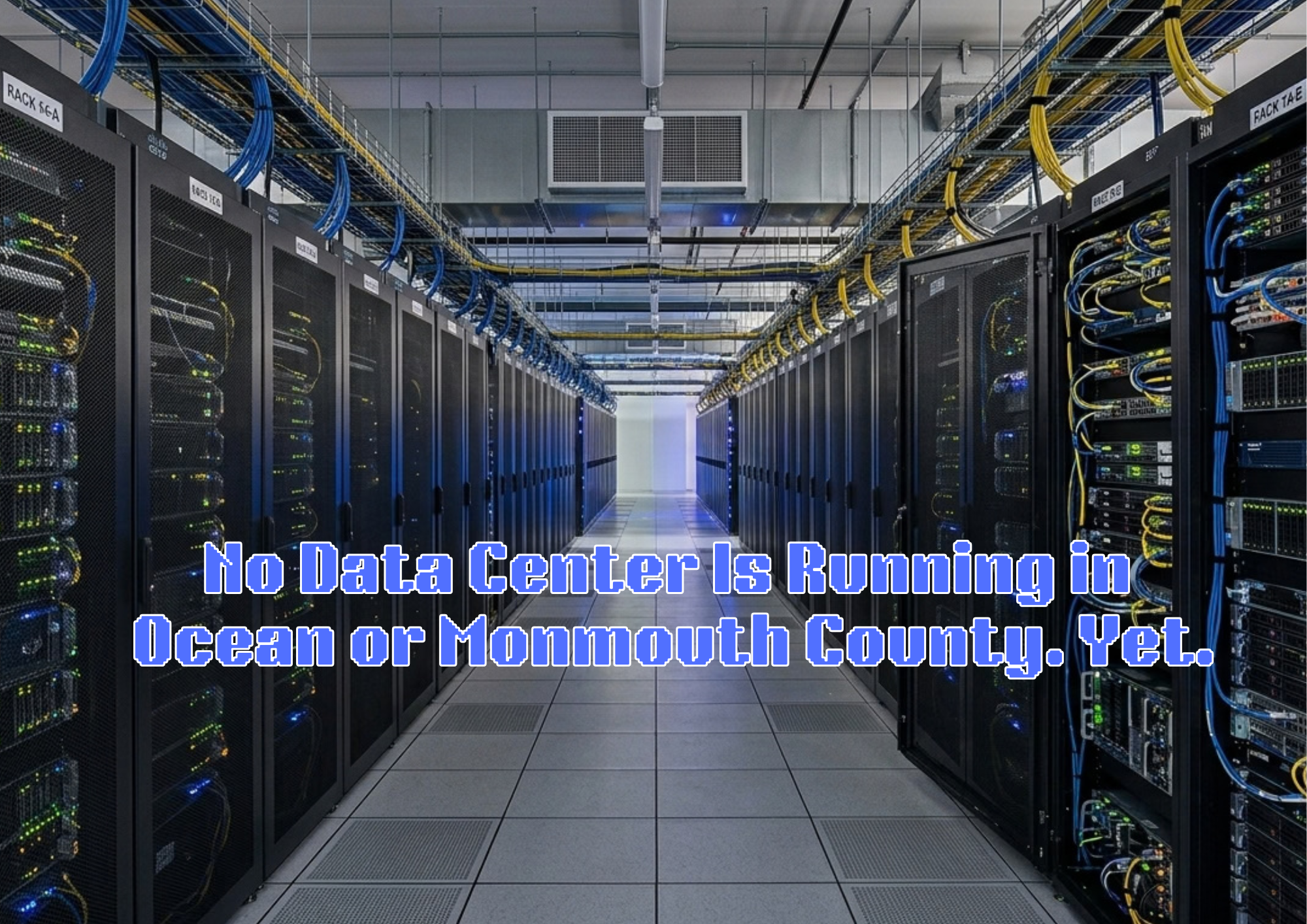
nobody in Ocean or Monmouth County is actually living next to a data center that's up and running. Not one is built or operating here right now. What's happening instead is a wave of townships getting out ahead of it before one ever shows up. Brick banned them outright, even though nobody has proposed one there. Jackson did the same in a close vote at the end of August and became the second town in the county to ban them that same week. Manchester pulled them out of its redevelopment plan entirely and named Barnegat Bay and the Pinelands as the reason why. Lacey hasn't seen an actual proposal either, but a meeting about it back in June packed the room after word got around that the old, decommissioned Oyster Creek nuclear site could be a target. And over in Holmdel, the township banned data centers in August, but a 40 megawatt facility proposed for the Bell Works site might get built anyway, because the developer filed paperwork three days before the ban passed and an old agreement from 2012 already allowed it on that property.
So that's the state of play.
Every one of these is a zoning fight happening before a shovel goes in the ground, not something already sitting in anyone's backyard.
Now, the property value question.
We looked into it rather than guess at it for you, and here's what's actually out there: nobody can point to a house down the shore that sold for less because of a data center, since none has been built here. What we did find is a recent survey of real estate agents nationally, and it came back close to split. About a quarter saw nearby values go up, about a quarter saw them go down. Buyer interest was similarly mixed. What decided which way it went had less to do with a data center existing somewhere in town, and a lot more to do with how close it was, whether you could see or hear it, and whether buyers in that market were already worried about their own electric bills climbing. A data center tucked behind a stand of trees a half mile off reads completely different to a buyer than one humming across the street. There's also a study out of Northern Virginia, the most data center heavy region in the country, where homes closer to the facilities actually sold for more. But that's a place that was already a strong tech job market before any of it got built, so we'd be careful applying that one to a Jersey Shore town.
Our take:
distance and visibility are going to matter far more than the fact that a data center exists somewhere in your township. And since nothing has broken ground here, anyone telling you it will definitely hurt your value, or definitely won't touch it, is telling you more than anyone actually knows right now.
Now the water and environment side, which is where most of the local pushback is really coming from.
A large data center can use several million gallons of water a day for cooling. A mid sized one can run through something like 110 million gallons a year, roughly what a thousand households use in that same year. On the power side, one large facility can pull as much electricity as charging a couple hundred thousand electric vehicles. New Jersey's own electric rates jumped about 20 percent this past summer, and that's part of why state lawmakers put forward a bill that would make data center operators report their water and power use to the public every quarter, something almost no other state requires yet.
Here's why that hits different in Jackson and Manchester specifically.
Both townships sit over the Pinelands and draw from the Kirkwood-Cohansey aquifer, the same water source that feeds the wetlands around Barnegat Bay and a lot of the private wells out that way. That's exactly why both councils named water, not electricity alone, when they passed their bans. It isn't an abstract worry for them. It's literally where their water comes from.
We're not here to scare anyone about this, and we're not going to wave it off either.
Right now this is a zoning story, not a resale story. If you're buying or selling near a big industrial lot, an old institutional property, or something like the retired Oyster Creek site, the useful thing to do is check what your specific town's ordinance actually says today, because it can change fast. Just ask Holmdel. We'll keep watching how this moves through Ocean and Monmouth County and tell you directly if something real lands near a property you're keeping an eye on.
Check out this article next